Facebook Instagram Pinterest TeachersPayTeachers BlogLovin Home Image Map
Showing posts with label categorization. Show all posts

March 24, 2017

Sensory Bins: Adding the Unexpected


Sensory bins are all the rage with speech-language pathologists on social media, and I have enthusiastically jumped on the bandwagon. I've used them sporadically throughout my career, both in Early Intervention and with my private practice caseload with fantastic results, but after seeing so many amazing sensory bin creations on Instagram by my fellow SLPs, my interest in using sensory bins on a regular basis has soared to new heights!

My latest sensory bin creation is zoo themed, and didn't really require much creativity at all. Here's what I did:

1. I put pinto beans in a tub.
2. I added animals and props from various zoo toy sets.

That's it. Done.

Zoo in a whole new way!

But here's where it gets good: I added some things that are very unexpected, things that you wouldn't necessarily find in a zoo play set.


I added mini erasers of all different sorts! There are donuts, french fries, trucks, apples, pencils and more!

Why? Because it blasted language learning opportunities through the roof!

Children are naturally drawn to nonsensical things, like feeding donuts to elephants instead of hay, and giving a giraffe a pencil to use. They think it's hilarious! And it gives me the opportunity to target a wider variety of goals:


  • Negation: elephants don't eat donuts, a robot is not a zoo animal, a giraffe can't hold a pencil
  • Categories: this depends on the types of objects you use
  • Silly Sentence Construction: The elephant ate the truck. The lion stomped on the donut.
  • Absurdities: Do pencils swim? Do tigers play with rubber ducks?
  • Sentence formulation: I like to choose an animal and an eraser and say, "Make up a sentence about a lion and a truck." This one is SO GOOD for my little friends who are so concrete and struggle to imagine silly scenarios. 
  • Answering "why" questions: Why don't zookeepers take care of robots?
  • Prediction: The zookeeper gave the elephant an ice cream cone. What do you think will happen next?
  • Imagination!
Felice over at The Dabbling Speechie has wonderful ideas for creating and using sensory bins in treatment. She even has a tab on her homepage dedicated to sensory bins that lists her posts and offers materials to help you get started. Her printable list of categories from her "I Spy" sensory bin inspired me to make my own picture lists to accompany my zoo sensory bin.


These little lists have been so useful! So far, I've used them to target plurals, matching, final /s/ and /z/, copula verbs, vocabulary, and the pronoun "I".

They have also been helpful in helping direct the play of little ones who typically tend to only like to sift the beans through their hands, or scoop and pour. The mini erasers grab their attention, and they like to match them to the pictures.


Of course, you must used caution when adding any small object to a sensory bin. Especially if you have little ones who like to put things in their mouths as they could become a choking hazard. Be extra diligent!

So, how about you? Do you currently have a sensory bin that you're using? Try adding something that's a little unexpected. I think you'll love the results!


December 30, 2015

Winter Find It on the Go


Today I am sharing one of my favorite products with you. It's called Winter Find it on the Go for Language Skills. It's been very popular with other SLPs and is currently featured as one of Super Power Speech's picks in her January Lesson Plans, so I thought I'd give you a preview of this fun and very FLEXIBLE product.


Winter Find It on the Go is a collection of 18 winter-themed search and find picture scenes in a flip book format. It is divided into 4 categories: Colors and Counting, Actions, Categories and Associations.  It also includes an Extra Target section, which lists additional targets that can be addressed for each picture scene.


It includes scenes for holidays (Hanukkah, Christmas and Valentine's Day),


polar animals, winter activities and familiar routines such as bedtime.


Each page lists targets to find and features a specific goal, such as past tense verbs. Students use a dry erase marker to circle the targets as they find them, and then wipe the page clean when they are finished.


If you're not working on the specific target listed on the page, flip to the back section for suggestions of other goals you can target! So flexible!!! In this 18-page book, you can target more than 40 different skills!


I find myself reaching for this product again and again. I've used it with every child on my caseload! It's even great to use with my articulation kiddos!

You can add this go-to product to your winter materials collection by clicking the link to my TpT Store.


July 28, 2015

Back to School Scavenger Hunts and I Spy Games


I know it's only the end of July, but I am already planning some of my back to school activities. I have a diverse caseload of kids in preschool through middle school, and I love to find activities that can be adapted to use with almost all of them. My kids just love treasure hunts, I Spy games and racing the clock in timed challenges, so I created this packet to include all three of those motivating activities.

This product features two colorful I Spy! game boards that can be used in a variety of ways.  I like to use them with my preschoolers to target categories, attributes, colors, letter recognition and object function. I just ask them to find "something in the sky" or "an animal that lives in the zoo", and have them cover the item with a checker after its found.


I use these boards in so many ways! I use them with the checklists that are included to find objects belonging to categories, but here are some other ideas:  Adapt it for working on S-blends by having the student say "I spy a ____" while finding each item. Use it to target negatives by finding items NOT in the category listed, and have them say, "A ___ is NOT a ____." or "A ____ DOESN'T have ____." Have the students direct others to find specific objects by describing them. Be creative! 


I've got a couple of older elementary students who struggle with processing information quickly and have difficulty with rapid naming tasks, so I created two rapid naming checklists to go along with each board. 


All you need is a stopwatch (there's probably one on your cellphone), a dry erase pouch to put the I Spy game boards in, a dry erase pen to cross off items as they are found, and a pencil to record the number of items found. I have the students name the items as they find them, often having them state the color of the object as well.


My older kids really love this one! Anytime they can race the clock, they are happy campers. This would be a great activity to target fluency, too.

The second part of this product is the set of five different scavenger hunt lists.  There's a color hunt for the little ones...


...ones that feature object functions, attributes and negatives...


...and one that targets social skills. I've even included an extension activity targeting follow-up questions.


These scavenger hunts are perfect to use one-on-one or with a group, or even for sending home as homework.  I haven't used them with my kids yet, but I just know they'll be a hit!

Want to add these to your back-to-school lesson plans? You can find them in my TpT Store, so just click on over.

Enjoy the rest of your summer!

Pam

March 23, 2015

It's National Puppy Day!

My Grand-Puppy Murphy!!!
I opened my computer this morning and discovered that it's National Puppy Day! It couldn't have come at a better time, because it's been all about dogs around here at Small Talk.  Want to know what we've been doing? Great! Because I can't wait to share!

We've been playing fun games like...


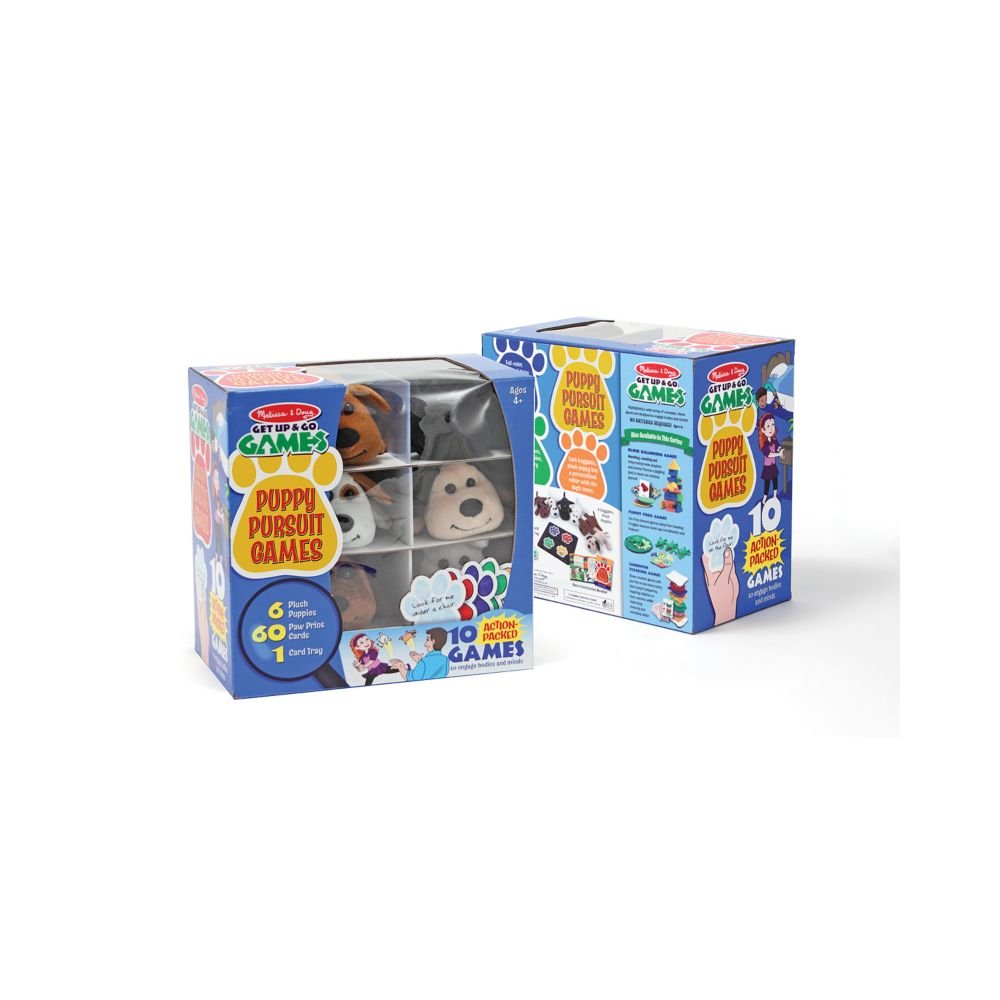
Puppy Pursuit by Melissa and Doug, which is so versatile with 10 different game possibilities. My kids just love playing hide and seek with the 6 adorable puppies! They never tire of this game!

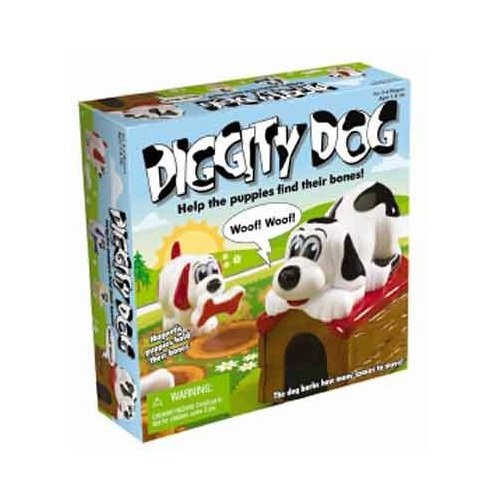
Another fun game is Diggity Dog, a color matching game great for working on colors, turn-taking, listening skills and following game rules.


I used a great book about dogs with my EET kit materials to work on organizing information from non-fiction text with my older kids:


...and this great pet hospital toy for pretend play.


But no dog week would be complete without celebrating my favorite little furry pup, Bruno!


My little buddy turned 6 years old last Thursday, so I created a whole packet of fun activities in honor of him!


It's got 8 delightfully fun activities that your kids will surely love, including Cariboo cards that can be used with your Cariboo game...


or without it by using bones to cover up the pictures if you leave them as a whole sheet, or by cutting the pictures out and hiding bones under them!


It includes 2 levels of auditory directions to make data tracking a breeze, which is something you don't often find with Cariboo card sets.

There's also a color matching game, a fun hide and seek game, an activity targeting verbs and WH questions, auditory comprehension paragraphs, a take-home book about Bruno's day, a category game and some open-ended materials.  My kids LOVED these activities and I'm sure yours will, too.  You can find it here.

Happy Puppy Day!!!

Pam 

February 13, 2013

Farmyard Slam!

I've just completed a new addition to my Slam!  game collection.  Introducing Farmyard Slam!  I'm really excited about this one because my games keep evolving, and this one has a couple of great extra features.  And, since this one isn't holiday themed, I can play it all year long!   I can't wait to share!

Farmyard Slam is most similar to Snowman Slam! game in that it has game boards in addition to playing cards.  There are four boards, each with a different farm scene.  Here's an example of two of them:


Aren't they cute???  I used the On the Farm collection from KPM Doodles, which couldn't be more perfect!  

I made the direction cards a little different this time, too, to throw in a little categorization work along with following directions.  They look like this:


Each card contains a symbol for the category, and color or feature symbols so pre-readers can give the directions, too.

So what are the bonus features?  You can use this activity to work on following auditory directions that contain categories and features, but you can also use it for other goals, too. 


This scene is at the top of the blue board.  You could use this to work on prepositions such as in, on, next to, behind and between.  You could have each child tell you three things about his or her farmyard scene using auxiliary and -ing verbs.  Or how about pronouns?  Each scene contains plenty of opportunities to work on these concepts and others.

Another fun bonus feature is a little hide and seek game.  Rascal Rooster is hiding somewhere in each farm scene.  Can you find him?  He's pretty easy to find in this scene, but he's pretty tricky to find in others.  Go back and look for him on the orange game board...you know you want to!  That is, if you haven't already!

I've also included three category cards that can be used for sorting the square picture cards by category. They look like this:

 So many ways to play!  And so many goals that can be targeted in one simple game.  Love that!

You can find Farmyard Slam and all my other Slam! games on my TpT site.  To go directly to Farmyard Slam!  click here.

Let me know what you think!


Pam


December 6, 2012

One Idea from Pinterest Turned into Multi-purpose Fun!

A couple of weeks ago I pinned this cute  What's in the Stocking activity from Pinterest:


It comes from a blog called Little Wonders Days and is such a great idea that I just had to try it!

Of course, everything I make or plan depends on the needs of my current caseload, so this one started as an activity to do with my s-blend kids.

I found 22 different objects whose names started with an s-blend and put them in a Christmas stocking. The kids removed them one at a time and used the carrier phrase, "I found the _______ in my stocking," giving them the opportunity to say two s-blend words in one sentence.


The kids enjoyed this activity, and I could have just left it at that, but I had to change it up a little.  I put all 22 objects in a mayo jar and filled the jar with rice.  I made a list of everything in the jar and gave it to the child with the instructions to find each item on the list by rolling, turning and shaking the jar.  The one firm rule was that they could NOT remove the lid.


This has been quite the hit, I have to tell you!  EVERY kid on my caseload is completely enthralled with it, and it's use has expanded way beyond /s/ blend articulation!  Yesterday I used it for the following purposes:

        *  /r/ sound carryover:  "I'm looking for ....", "It's right there.", "Here is the ....."

        *  Categorization:  How many things are Christmas Things, Winter Things or Other?

        *  A distraction activity for a girl with tongue thrust to practice her resting posture for 5 minute
             segments

        *  Improving processing time/speed of task completion:  I have a couple of kids on the spectrum who take a lot of time to execute the steps necessary to complete a task.  We used a stopwatch and raced to see how many objects we could find in 3 minute segments.

        *  Following steps of a process:  I used the list worksheet and added category boxes.  We found an  item on the list, crossed it off, and then recorded it in the category box.  Sounds easy, right?  It wasn't for this particular second grader.  He needed to be reminded to complete the last step in almost half of the opportunities.

        *  My littles liked it too.  We worked on action words like shake, roll, and tip.  We just named things that we saw.

These are the worksheets that I made to go with the jar.  The first one is the list...


...and the second one is the list with the category boxes.  I'd share them with you, but your list will be different then mine.


These activities were actually very easy to put together.  Finding all the objects was the hardest part!  I hope you'll try it.  If  you do, please share with me how you used it.


Pam

November 27, 2012

Christmas Brainstorm

Earlier in the month I posted a worksheet for thinking about Thanksgiving.  It worked so well for me that I made a Christmas version.  It was created for use with the Expanding Expression program, but you could easily use it without utilizing those methods.  I find it is a great way to get kids talking about what they know and expand their vocabulary.

Download your copy here.  Graphic credit goes to Scrappin' Doodles.  I hope you'll find this useful, too!

Pam


October 30, 2012

Quick Last-Minute Halloween Activities

Need a quick last-minute Halloween activity but don't have much time to prep?  I've got a couple of great ones!
Here's one I've been using A LOT over the past couple of weeks.  I found some great Fall dot paint sheets  at 3dinosaurs.com.  The Fall Pack Extras has a variety of apples, leaves and pumpkins; the pumpkin is the one I used the most and is pictured at left.
So what did I do with it?

1.  I printed and laminated it and used it as a play dough mat.  I used orange play dough to make little balls, and gave them to the child one at a time after saying targeted words or phrases.  The kids promptly smashed them on the mat!  Many of them tried to cover the entire pumpkin with a layer of smashed play dough.  Fun for them, and a great way to get many reps in a short amount of time.

2.  I printed it out and used it with dot paints for several different purposes.  As an articulation activity, I glued small pictures above each vertical row.  The child would say the word and make one dot with paint for each dot in the row.  I also used it as a categorization activity.  I wrote category names above each row and had the child name 4 items in each category, making a dot for each item named.  Here's an example of one I used:


Here's another fast and easy Halloween craft:  Mummy Lights!


I saw this one on Pinterest, and just had to try it!  There was no website linked to the picture, so I don't know who to credit on this one, but it was easy enough to recreate by myself.  Here's what you need:


Gauze strips cut into 3-4" pieces, a jelly jar, wiggly eyes, tape and a tea light candle.  You can use this target any articulation sound you want by giving the child a piece of gauze after saying target words or phrases.  The child I worked with today requested "Sticky tape" twice for each gauze strip, because we are working on /st/ in two-word phrases.  The child uses the tape to attach the gauze to the jar.  All you need is a small piece of tape at each end.  After the jar is completely covered, simply glue on wiggly eyes (and a smile, if you want your mummy to look more silly than scary).  Then put the candle inside. That's it!  Look how ours turned out:


So cute!!!

Happy Halloween!


Pam

July 27, 2012

Let the Games Begin!

I don't know about you, but I have caught Olympic Fever!  I can't wait for the opening ceremonies to begin!

Today I borrowed an idea from Pinterest, using an Olympic Rings printout, which you can find right here.  I used this handout for a categorization/word association activity.


I wrote different category names in each circle, and got my dot paints out.  I instructed the child to name  eight items in a category, and to paint a dot after naming each one.  To make it a little more difficult, I used my stopwatch to see if she could name all eight in less than one minute.  Easy!

I used this same idea earlier in the week as an articulation activity, too.  We just glued pictures of the target words in the center of each ring, and said each word eight times.


One of the things I like to do each summer is make "Camp Journals" for each of my kiddos.  I plan my summer around Summer Camp Mini-Themes, and the kids collect "merit badges" for completing tasks centered around each theme.


I make the covers out of foam, and add five blank pages to each.  You can download my template for the pages here.   The kids decorate their journal covers with the letters of their names and other fun foam stickers.

I make the badges ahead of time, using my Cricut paper cutter, which can make just about any shape you can dream of.  I cut tons of two inch circles for my badges, and then shapes to match my mini-themes.  Here are some of my badges:


They include Forest Animal Expert, Sports Fanatic, Camping Pro and Olympic Champion.  I'm not sure what I'll name the one with the marshmallows on the stick yet, but I know we'll be making s'mores one of these days with my indoor s'mores maker!  We've got to earn a badge for that, right?

Each week, I write a list of goals on a blank page of each journal, and write the name of the badge at the top of each page.  For example, to earn the Forest Animal Expert badge, the child must name at least 5 different animals that live in the forest, name at least three important features of each, and tell me at least one interesting fact about each one.

I also make special badges for kids who are working on the R sound, and those who are working on establishing correct tongue positioning at rest.  My vocalic R pages look like this:


The symbol on the badge matches the vowel set:  a bear for AIR words, a star for AR words, a fire for IRE, and a deer for EER.  Sometimes I write the target words on each page, and sometimes the kids do it themselves.


The child above was working on vocalic R in single words, specifically the OR words.  He earned his badge because he was able to say the entire list correctly, which was the goal.

The kids enjoy earning the badges and are proud to fill their journal.  I keep them with me until they are complete, but the kids review each earned badge with their parents after each session, and then take them home at the end of summer.

If you're interested about what tasks I'll have my kids complete to earn their badges, let me know and I will post sample pages from their journals.  Next week we are working on our Olympic Champion badges so...


...let the games begin!!!

Pam